Fascinating new interview with Greg Marino in which he demonstrates his forgeries. Fakes are obvious today.https://t.co/bownQP9wm2
— 🚀 Steve Zarelli 🚀 (@SteveZarelli) October 14, 2017
Showing posts with label Forgery. Show all posts
Showing posts with label Forgery. Show all posts
Sunday, November 05, 2017
Greg Marino: Watch a forger at work


Monday, March 06, 2017
Donald Trump Autographs... be very careful!
President Donald Trump autographs may be the hottest signature on the market right now, and also the most dangerous. His campaign trail scribbles are a forger's dream. It doesn't exactly take a master forger to imitate that style. My recommendation would be to focus on his older style signatures, which you have a reasonable chance to authenticate with some level of confidence.
To further complicate the matter, there are Autopen machine signatures in the 2016 Election Edition The Art of the Deal books that were sent to donors. They are NOT authentically hand-signed. eBay is full of these Autopen machine signed books with sellers asking $300 and up. As you can see in the graphic, the signature is exactly the same in all of the books... there is no doubt these were signed by an Autopen machine.
To further complicate the matter, there are Autopen machine signatures in the 2016 Election Edition The Art of the Deal books that were sent to donors. They are NOT authentically hand-signed. eBay is full of these Autopen machine signed books with sellers asking $300 and up. As you can see in the graphic, the signature is exactly the same in all of the books... there is no doubt these were signed by an Autopen machine.
 |
| Autopen machine signatures in The Art of the Deal. |
Monday, July 06, 2015
Charlton Heston autographs... more fakes than ever on eBay
Every once in a while I must slow down and observe the car wreck that is Charlton Heston autographs on eBay. Four years after the Charlton Heston secretarial study, they still abound unabated. Of the first 25 listings, at least 13 are not authentic. That is a 52% fake rate.

Wednesday, June 10, 2015
Forger Greg Marino: Still bringing in the bucks
The FBI busted the Operation Bullpen forgery ring, including
the primary forger, Greg Marino, over 15 years ago. Yet his work still pollutes
the hobby today.
At the time, Marino’s “Mickey Mantles” were considered deceptive
fakes; but they are glaringly obvious by today’s standard. Yet, fish are still
taking the bait.
Here is someone who spent $419.14 on a worthless Greg Marino penned Mickey Mantle forgery on eBay.

Saturday, November 22, 2014
True Story About The Forgeries Sold By Bergen County NJ’s Baseball Memorabilia Auction: Expose by WPIX TV
WPIX Channel 11 in New York ran an expose of the forgeries sold in the Bergen County, New Jersey Baseball Memorabilia Auction. The three part piece is excellent and well-researched. Kudos to the reporter, Howard Thompson, who really did his homework.
Wednesday, February 19, 2014
Are Steiner holograms compromised?
On July 21 of last year I wrote about a suspect Derek Jeter autographed hat with a Steiner hologram. In the interim, there have been more scattered reports of suspect items bearing Steiner holograms.
This item is currently on eBay with a highly suspect Mariano Rivera autograph and bearing a Steiner hologram.


This item is currently on eBay with a highly suspect Mariano Rivera autograph and bearing a Steiner hologram.

I'm not implying any wrongdoing on the part of Steiner because it is clear they are a reputable company who sells authentic material. But have their holograms been compromised? Is someone counterfeiting them or have dishonest people devised a way to remove them from authentic items without damage and place them on bad items?
Steiner has a very valuable reputation to protect and they need to get to the bottom of this. As I wrote in my previous post, if collectors begin to lose confidence in first party autograph distributors like Steiner, it would be a significant blow to the entire market.
Thursday, August 22, 2013
A case of Mariano Rivera forgeries
Submitted for your viewing displeasure, a case of junky ghetto Mariano Rivera forgeries.

This mass-produced forgery style is well known and not very well done. However, they apparently fooled ACE Authenticator Justin Priddy who authenticated them for Live Sports Auctions.

This mass-produced forgery style is well known and not very well done. However, they apparently fooled ACE Authenticator Justin Priddy who authenticated them for Live Sports Auctions.
Sunday, July 21, 2013
Are authenticity holograms secure enough?
Here is a "Derek Jeter" signed hat on eBay with a Steiner hologram and generic Steiner card, which states "Derek Jeter Autograph."


At best, this signature is highly suspect. Additionally, it appears to be a cheap knock off hat -- note the oversized NY logo and it is probably an adjustable cap as well. Is it likely that Steiner is selling Derek Jeter signed items on unofficial merchandise?

So, this leads me to believe it is either a real Steiner hologram removed from another item or a counterfeit Steiner hologram. Either way, it does not bode well. As reported on Net54, it seems that bad items are appearing with otherwise credible holograms with more and more frequency.
If they are counterfeits, Steiner, MLB and the third party authenticators need to go after the sellers and find out where they are coming from.
If they are legit holograms removed from other items, these holograms are not secure enough and need to be redesigned so they tear apart if removed. I know from personal experience I had a Steiner hologram fall off of a game used ball with only a tiny fleck of the backing being damaged.
A lot of collectors only trust items from supervised signing such as Steiner, MLB, TriStar, etc. If the credibility of these holograms comes into question, these collectors will leave the hobby and that is bad for all of us.
Monday, June 17, 2013
Thursday, May 30, 2013
How responsible are the buyers of fakes and forgeries?
I found this interesting article in Coin World magazine. It's about someone (an art dealer) who purchased a fake painting and later sued. A New York court ruled that it was the buyer's responsibility because the buyer knew it could be fake, and did not exert due diligence -- that is, have it checked by experts -- prior to the purchase.
Of course, this scenario can be applied to all risky areas of collecting.
While I am not one to ever side with shady sellers, the article makes a strong case that there is responsibility on the part of the buyer to properly inspect an item before it is purchased.
#######
Accountability matters
By Armen R. Vartian
Article first published in May 20, 2013, Expert Advice section of Coin World
I recently received an email from a Coin World reader asking what remedies a coin buyer would have if he purchased “raw” (uncertified by a third-party grading service) coins from a dealer as Mint State 60 or Mint State 63, and then the coins were returned “no graded” (were rejected for encapsulation) upon submission to a major grading service.
Answering his question got me thinking about the impact of grading services in the industry generally, and also about a legal doctrine applied to sales of art and set forth in a recent federal court decision in New York.
Facts simple
The facts of the New York case were simple.
A collector wanted to sell a painting by Milton Avery, and sent the painting to a warehouse in New York City where, as the court noted, “any prospective buyer ... could inspect it.” A firm ended up buying the painting for $200,000, after the firm’s president inspected it at the warehouse.
Shortly thereafter, this firm, a dealer, submitted the painting to the Avery Foundation, which declared it a fake. The collector refused to make a refund. The court sided with the collector.
Siding with the collector
First, it declared that although both parties may have been mistaken as to the painting’s authenticity, the dealer was negligent in not having the Avery Foundation examine the painting before the purchase transaction, rather than afterward.
The court also noted that even if the seller knew the painting was a fake, the dealer had every opportunity to have the painting inspected by the foundation, and therefore couldn’t reasonably have relied upon any statements the seller made about authenticity.
The federal court emphasized that the foundation had sent the seller a letter stating that its representatives were willing to travel to the warehouse for an inspection, and that the dealer should have done more than merely have its president look at the painting himself.
Inspect before buying
Citing other cases involving failure to properly inspect real estate to discover defects, the court concluded, “The very fact that [the dealer] felt the need to seek authentication by the Avery Foundation after the purchase indicates that it knew how to do so prior to the purchase.”
It’s not clear how my reader’s situation is affected by this. In the stamp collecting field, it is normal for buyers to require expertization before concluding a purchase.
I say “concluding” because sometimes the stamps are submitted before money changes hands, and other times the transaction is completed subject to the buyer having the right to rescind if the stamps are found to be inauthentic.
No such practice exists for coins, in part because so many coins are already certified. Nevertheless, raw coins still are bought and sold with some frequency.
Consider certification
Would it be fair for a court to chide a buyer of fake or overgraded coins for not having had the coins submitted to the grading service before he purchased them?
Many, if not most, sellers would balk at such a requirement, and simple sell to someone else. And the buyer in the New York case was a dealer, who presumably knew the risks.
Shouldn’t collectors also be held responsible for knowing the risks of buying uncertified coins?
Shouldn’t collectors also be responsible for knowing that, for coins of coins of substantial value, if they aren’t certified, it might be because they aren’t genuine or are overgraded?
Armen R. Vartian is an attorney and author of A Legal Guide to Buying and Selling Art and Collectibles.
Collectibles and Law column | Coin World
Of course, this scenario can be applied to all risky areas of collecting.
While I am not one to ever side with shady sellers, the article makes a strong case that there is responsibility on the part of the buyer to properly inspect an item before it is purchased.
#######
Accountability matters
By Armen R. Vartian
Article first published in May 20, 2013, Expert Advice section of Coin World
I recently received an email from a Coin World reader asking what remedies a coin buyer would have if he purchased “raw” (uncertified by a third-party grading service) coins from a dealer as Mint State 60 or Mint State 63, and then the coins were returned “no graded” (were rejected for encapsulation) upon submission to a major grading service.
Answering his question got me thinking about the impact of grading services in the industry generally, and also about a legal doctrine applied to sales of art and set forth in a recent federal court decision in New York.
Facts simple
The facts of the New York case were simple.
A collector wanted to sell a painting by Milton Avery, and sent the painting to a warehouse in New York City where, as the court noted, “any prospective buyer ... could inspect it.” A firm ended up buying the painting for $200,000, after the firm’s president inspected it at the warehouse.
Shortly thereafter, this firm, a dealer, submitted the painting to the Avery Foundation, which declared it a fake. The collector refused to make a refund. The court sided with the collector.
Siding with the collector
First, it declared that although both parties may have been mistaken as to the painting’s authenticity, the dealer was negligent in not having the Avery Foundation examine the painting before the purchase transaction, rather than afterward.
The court also noted that even if the seller knew the painting was a fake, the dealer had every opportunity to have the painting inspected by the foundation, and therefore couldn’t reasonably have relied upon any statements the seller made about authenticity.
The federal court emphasized that the foundation had sent the seller a letter stating that its representatives were willing to travel to the warehouse for an inspection, and that the dealer should have done more than merely have its president look at the painting himself.
Inspect before buying
Citing other cases involving failure to properly inspect real estate to discover defects, the court concluded, “The very fact that [the dealer] felt the need to seek authentication by the Avery Foundation after the purchase indicates that it knew how to do so prior to the purchase.”
It’s not clear how my reader’s situation is affected by this. In the stamp collecting field, it is normal for buyers to require expertization before concluding a purchase.
I say “concluding” because sometimes the stamps are submitted before money changes hands, and other times the transaction is completed subject to the buyer having the right to rescind if the stamps are found to be inauthentic.
No such practice exists for coins, in part because so many coins are already certified. Nevertheless, raw coins still are bought and sold with some frequency.
Consider certification
Would it be fair for a court to chide a buyer of fake or overgraded coins for not having had the coins submitted to the grading service before he purchased them?
Many, if not most, sellers would balk at such a requirement, and simple sell to someone else. And the buyer in the New York case was a dealer, who presumably knew the risks.
Shouldn’t collectors also be held responsible for knowing the risks of buying uncertified coins?
Shouldn’t collectors also be responsible for knowing that, for coins of coins of substantial value, if they aren’t certified, it might be because they aren’t genuine or are overgraded?
Armen R. Vartian is an attorney and author of A Legal Guide to Buying and Selling Art and Collectibles.
Collectibles and Law column | Coin World
Saturday, March 02, 2013
Beware of inkjet printed autographs
This Neil Armstrong signed "cut" was sent to me recently for review. The moment I took it from the envelope my radar went off because it was not a 3x5 index card, but printer photo type paper cut to the shape of a 3x5 card.

I also immediately knew something was amiss because the signature seemed too "flat." It was on the surface of the paper, but there was no ink streaking.
Here is what it looked like under magnification:


I also immediately knew something was amiss because the signature seemed too "flat." It was on the surface of the paper, but there was no ink streaking.
Here is what it looked like under magnification:

So, it was a high quality inkjet print. This "signature" is composed of dots, not ink from a pen.
I have seen a number of these printed signatures and it appears to be a growing problem. Often they are matted in a display -- at arm's length and under glass they can be more deceptive. As always, caveat emptor!
Saturday, February 02, 2013
Neil Armstrong signed baseball: Is it real, or is it Memorex?
Once in a while, you'll find a fake autograph and know precisely where it was copied from.
In the Fall 2012 RR Space Auction, I reviewed and authenticated this Neil Armstrong signed baseball.


In the Fall 2012 RR Space Auction, I reviewed and authenticated this Neil Armstrong signed baseball.

Today, I stumbled across this alleged Neil Armstrong signed baseball at Coach's Corner Auctions.

In my opinion, the Coach's Corner example was almost certainly modeled from the authentic exemplar offered by RR Auction. But note the slowness, hesitation and lack of confidence in the Coach's Corner ball.
Thursday, December 20, 2012
Julien's Michael Jackson auction controversy
The story originally broke on Autograph Magazine Live, and it has now been picked up by the national media. Are the Michael Jackson signatures from The Collection of Tompkins and Bush forgeries?
View more videos at: http://nbclosangeles.com.
Note that Julien's Auctions filed a Copyright Infringement Claim against Autograph Magazine Live (AML) for images used from the Tompkins & Bush sale. AML contends they are allowed to use them under Fair Use laws for discussion and criticism, and AML is filing a counterclaim.
Note that Julien's Auctions filed a Copyright Infringement Claim against Autograph Magazine Live (AML) for images used from the Tompkins & Bush sale. AML contends they are allowed to use them under Fair Use laws for discussion and criticism, and AML is filing a counterclaim.
Wednesday, December 19, 2012
How to tell authentic autographs from fakes
Very often you'll see a collector ask something along the lines of, "How can I tell a real [fill-in-the-blank] autograph from fakes?" It seems as though the person expects to receive an answer such as, "If the third stroke of the M is more than 1.5 inches long, it's fake."
Of course, it is not that simple. There are no shortcuts or magic tells. Most anyone can identify grossly malformed fakes. But to be really good and identify the relatively deceptive fakes, you need to train your eyes to recognize the proper look and feel. And this is not something that can be accomplished overnight. In other words, it requires work and dedication.
So, how do you "train your eye"?
- Look at hundreds of authentic exemplars. Look at them every day for a long time. And make sure you are using verified authentic exemplars!
- Do side-by-side comparisons with known fakes.
- Don't focus solely on "shape." Look at speed and pressure and other subtle characteristics. Good forgers can closely replicate "shape," but it's much more difficult to replicate the subtle characteristics.
- Look for a loose, relaxed hand that intuitively and instinctively signed versus a tight hand "drawing" the signature with too much "thinking."
- Network with experienced collectors and dealers to compare notes and ask questions.
Follow these steps and eventually the signature will "click," and you will see the difference between authentic and good fakes.
Sunday, July 15, 2012
James Stewart - Suspected Forgery Style Alert
Over the past few months I have noted an explosion of this James Stewart signature style on eBay. It seems as if some sellers have an endless supply of these signatures and they all have the same unusual characteristics.

- A sharp, "jerky" appearance
- Letters smashed together with poor letter definition
- Odd spacing between letters
- Never personalized
- Many of them do not appear to be on glossy photos... they are on cardstock prints
I have consulted with other experienced collectors and autograph industry professionals -- the consensus is these signatures are highly suspect.
Note this suspect style also appears on Harvey sketches.
Saturday, June 30, 2012
Pitiful Neil Armstrong / Apollo 11 Forgery
Finding a Neil Armstrong or Apollo 11 forgery is hardly a newsworthy event. They haunt the hobby like the ghost of phantom forensic document examiner Nicholas Burczyk.

However, every once-in-a-while I run across one so horrific it deserves honorable mention for inclusion in the Autograph Hall of Shame. Check out this train wreck, currently on eBay for a $5,999 Buy It Now...
 |
| World's least deceptive Apollo 11 forgery? |
Of course, the item would not be complete without a certificate of authenticity from a forensic document examiner. In this case, the "expert" forensic document examiners at Academy of Manuscript and Autograph (AMA) deemed this gem "authentic."

Tuesday, June 26, 2012
Operation Bullpen and the Marino Family Forgery Ring: Did anything change?
 |
| Ghastly Mariano Rivera forgery being sold today in mass quantities. Where is Operation Bullpen Part II? |
Something that really struck me this time around was how self-conscious the ring was about their product being “high quality” and how nervous they got when “someone was onto them.” For instance, the book recounts an incident where a collector returned a Jackie Robinson signed ball and a Roberto Clemente signed ball because he discovered the date of the balls made it impossible for them to be signed by Robinson or Clemente.
The leader of the ring, Wayne Bray, went into a fury because of this sloppiness and was especially angry at James DiMaggio (J. DiMaggio COAs) for issuing certs for these provably fake items. They counted on DiMaggio to rubber stamp items, but he was also essentially quality control. If something was a poor quality forgery, DiMaggio was not supposed to cert it.
Further, they got really nervous when some of the sellers they distributed to were removed by eBay. Once their sellers started getting removed from eBay, they feared law enforcement would soon follow. (Which it did.)
What makes this so interesting is the contrast with many of the fakes we see today certed by the usual suspects on the eBay banned COA list. The usual suspects on the eBay banned list – as well as some others – cert items that are laughably bad and obvious forgeries. There is no “quality control.” They apparently thumb their noses at law enforcement with no fear of consequences.
What makes this so interesting is the contrast with many of the fakes we see today certed by the usual suspects on the eBay banned COA list. The usual suspects on the eBay banned list – as well as some others – cert items that are laughably bad and obvious forgeries. There is no “quality control.” They apparently thumb their noses at law enforcement with no fear of consequences.
Blogs and message board threads like this one would have sent Wayne Bray and the Marinos into cardiac arrest. Yet, today’s crop of forgers, sellers and their “authenticating” accomplices don’t seem to care if almost every educated collector and dealer in the world is “onto them.” As long as there is a “greater fool” willing to buy their product, they plow on… offering countless obviously bad items in scores of venues.
So, how is it a decade after the biggest forgery bust in the world, the autographed collectibles market is perhaps flooded with more fakes than ever?
Thursday, March 08, 2012
ACE Authentication and CSC inducted into eBay Hall of Shame
You didn't have to be Nostradamus to see this one coming...
As of March 2, 2012, ACE Authentication and CSC Collectibles, have been added to eBay's Banned COA list.
Justin Priddy, formerly of GAI, is the owner/lead authenticator of ACE. If you see Justin Priddy at a card show, perhaps you can ask him what it feels like to join the ranks of Chris Morales, Ted Taylor, Don Frangipani and Operation Bullpen related COAs.
Perhaps Nostradamus has some insight into who else will be joining the eBay Hall of Shame shortly...
Here is the complete list of eBay banned COAs/Authenticators.
Autographed items with COAs and LOAs, or references to COAs and LOAs from the following people or organizations:
- ACE (Autograph Certification Experts)
- Coach's Corner Sports Auctions LLC
- Christopher L. Morales
- CSC Collectibles
- Donald Frangipani
- Forensic Document Services
- Hollywood Dreams
- J. DiMaggio Co. / J. DiMaggio Company
- Legends Sports Memorabilia
- Nathan's Autographs / N.E. Autographs
- Nicholas Burczyk
- Pro Sports / Pro Sports Memorabilia
- Rare and Signed.com
- Robert Prouty
- R.R.'s Sports Cards & Collectibles
- SCAA / Front Page Art / Angelo Marino
- Slamdunk Sportscards & Memorabilia
- Sports Alley Memorabilia
- Sports Management Group
- Stan's Sports / Stans Sports Memorabilia
- TTA Authentic (formerly STAT Authentic)
- Universal Memorabilia
- XMI Authentications
- USA Authentics
- Blank COAs and LOAs
- COAs and LOAs as stand-alone items
- COAs and LOAs from anyone listed on the FBI's Operation Bullpen web site
Tuesday, January 24, 2012
Steiner COA with half fake Rivera
 |
| Authentic Steiner Rivera signature with suspect inscription. |
In my opinion, the signature is 100% legit as one would expect from Steiner. However, something wasn't quite right about it. I think the "Enter Sandman" inscription has been forged.
The inscription appears tentative and does not match well with authentic exemplars. Further, the postioning of "Mariano Rivera" could indicate that it was signed with no intent to add an inscription below the name. Often, Rivera will sign higher on the ball when he plans to add an inscription below.
 |
| Authentic Steiner Rivera with authentic inscription |
For your comparison, I have included a Steiner certified ball with an authentic "Enter Sandman" inscription.
Friday, January 20, 2012
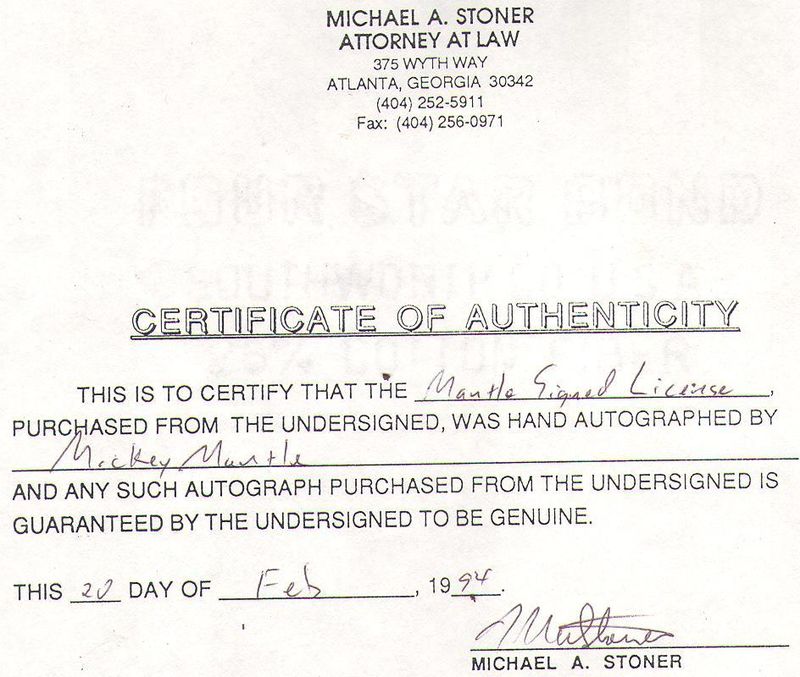
A Stoner COA

Exhibit A: Certificates of Authenticity from Michael A. Stoner, Esq. Does anyone know this guy? Who goes to a lawyer to authenticate or buy an autograph?
What's next, Marcus Welby, MD COAs?
Subscribe to:
Posts (Atom)